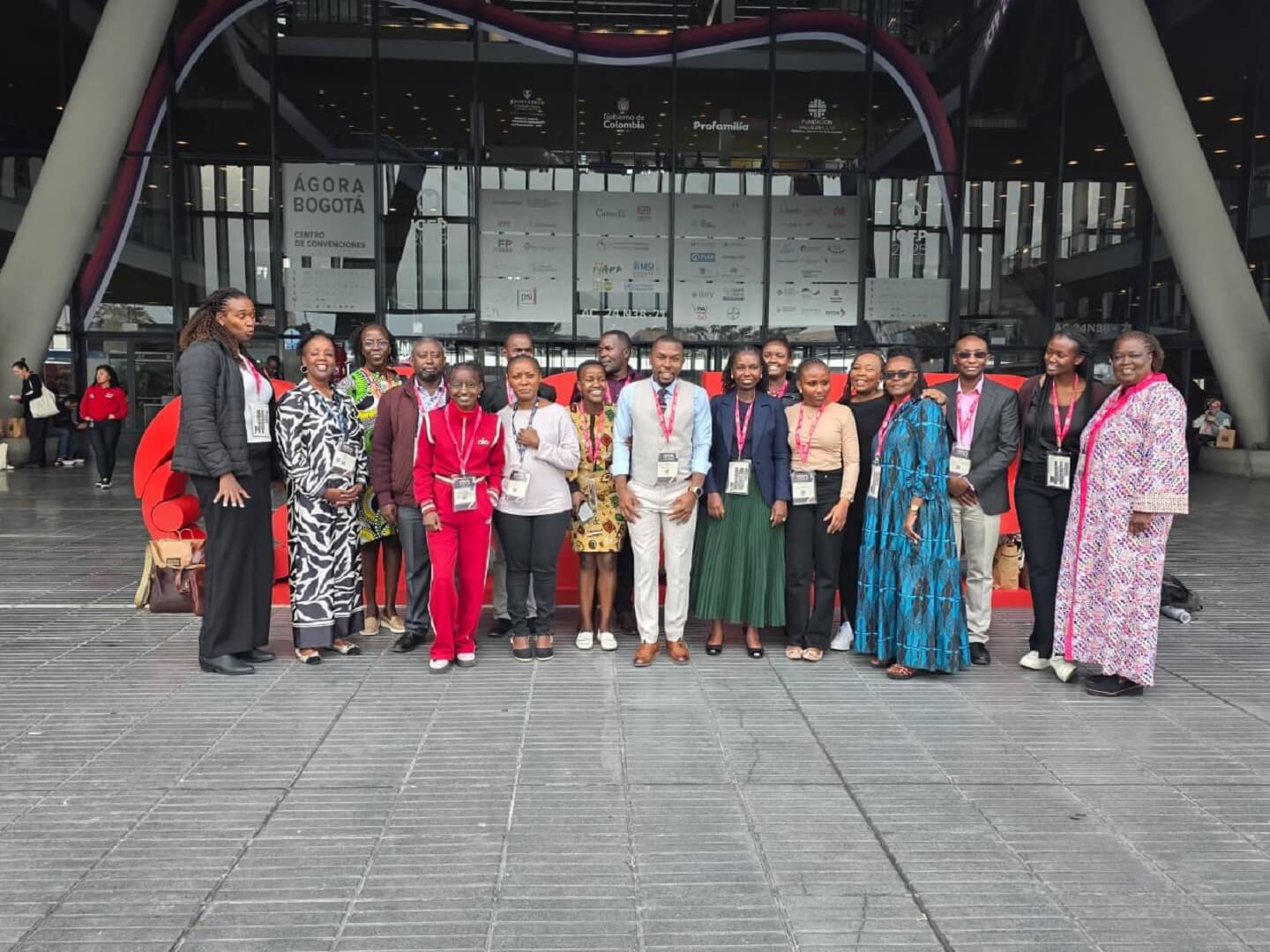
The call to action echoed across Bogotá this November. “Equity Through Action: Advancing Sexual and Reproductive Health and Rights for All” arrived at a moment when shifting funding landscapes, social barriers, and widening inequalities demand urgent, coordinated responses. The global community gathered to ask a defining question: How do we ensure that every person, regardless of geography, gender, culture, or economic status, can fully exercise their reproductive health rights?
PS Kenya’s delegation, led by CEO Dr. Margaret Njenga and Programs Coordinator for Business Development Israel Nzuki, stepped into that conversation with lived experience, tested evidence, and a clear vision for a more equitable future.
Israel contributed to the session “From Insight to Implementation: Community-Based SBC for Inclusive Family Planning,” where he spotlighted one of PS Kenya’s most powerful lessons from the Delivering Sustainable and Equitable Increases in Family Planning (DESIP) programme: the path to FP2030 runs through communities, not just clinics. In many hard-to-reach counties, he noted, the greatest barriers were not commodities but deeply rooted social norms. “Traditional supply-driven approaches were hitting a social wall,” he said. “Communities were telling us clearly: address our fears, engage our men, listen to our leaders.”
He shared how PS Kenya’s social behavior change approaches, co-created with women, men, youth, and local leaders, shifted perceptions around family planning by grounding solutions in lived realities rather than imposing them from the outside. What resonated most was the understanding that service delivery and SBC are two interlocking gears of health systems strengthening. If one stops, the whole system seizes up. Sustainable progress requires investing in human insight just as much as in clinical infrastructure. His message positioned PS Kenya as a thought leader championing community-led, equity-driven approaches that unlock long-term change.
A similar emphasis on systems and resilience shaped Dr. Margaret Njenga’s contribution to a high-level panel discussing Kenya’s coordinated advocacy response to sexual reproductive health and rights funding shocks. Joined by representatives from FP2030, NCPD, RHSC, and Impact for Health, she highlighted the rising importance of private sector partnership in sustaining health outcomes amid shrinking external funding. “We’ve seen partnerships evolve from donor-led to private-sector-anchored collaborations that can withstand shocks,” she said. “The private sector has shown it can carry us through tough times.”
She explained how this model enhances equity by ensuring that market-based solutions responsibly serve those able and willing to pay, while donor and philanthropic resources are preserved for those most in need. Her remarks positioned PS Kenya as a strategic connector, bridging public, private, and philanthropic actors to advance equitable SRHR outcomes and ensuring that resources flow where they can have the greatest impact.
Beyond PS Kenya’s contributions, ICFP 2025 revealed powerful shifts shaping the future of family planning. Delegates emphasised the need for smarter, more coordinated advocacy, with countries aligning around shared pathways rather than fragmented efforts. Sustainability emerged as a universal priority, with a call to move beyond short-term projects toward market-oriented, resilience-driven models, a space where PS Kenya has long led the way. Speakers emphasized the importance of intersectionality, recognising how gender norms, disability, economic constraints, and climate shocks overlap to shape access. Youth voices were not only present but influential; designing, innovating, and advocating in ways that signal a generational shift. A strong spotlight also shone on domestic financing as governments outlined new strategies to anchor SRHR within universal health coverage commitments and reduce donor dependency.
The energy of Bogotá, and the shared conviction that a more equitable future is within reach, now fuels PS Kenya’s mission back home. The conference may be over, but the work ahead is just beginning. We return with a renewed commitment: to expand SBC interventions that build lasting agency, to strengthen health systems by deepening private sector pathways and reinforcing collaboration with government and communities, and to ensure every decision is grounded in youth voices, gender-responsive principles, and robust data.
This is our promise: to transform global inspiration into tangible progress in every community we serve. And while our resolve is strong, real equity is written through partnership. Let us build a future where every choice is respected, every right is realised, and every person in Kenya can shape their own destiny.